aiX Weekly — AI in Higher Education (July 15th, 2026)
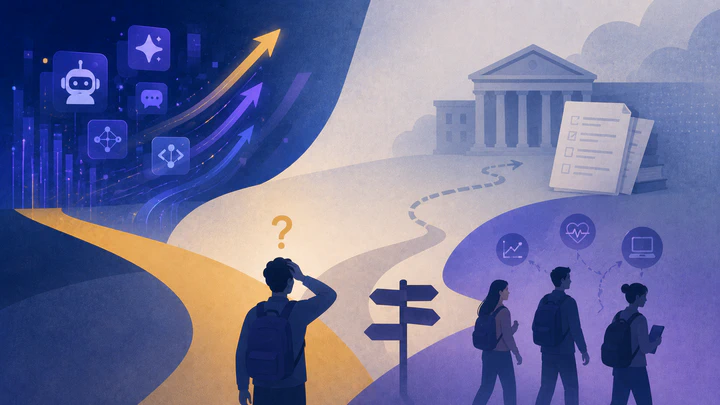
This week’s post examines the widening gap between near-universal AI adoption and institutional readiness — from Microsoft and Gallup survey data to the platform competition at ISTE 2026.
Each aiX Weekly issue is organized around a set of recurring sections and pairs with our companion AI and Higher Education timeline, which traces the broader arc of how AI has reshaped higher education since late 2022.
Curated by Claude for the aiX Programs, Columbia University. AI can make mistakes and so is the human reviewer. Please double-check the linked sources.
Reviewed by Tian Zheng on July 14th, 2026.
TL;DR
- Microsoft’s 2026 AI in Education Report finds 92% of students use AI for school — but 77% have received no formal training (Research Highlights)
- Nearly half of college students have considered switching majors over AI career concerns — the Lumina-Gallup study documents workforce anxiety reshaping enrollment in real time (Institutional Movements)
- Google and Microsoft both launched major AI education tool suites at ISTE 2026 — the platform competition for classroom AI is now explicit (What’s in the News)
- Frontier AI models now score ~30 points above human PhD experts on graduate-level science benchmarks (Most Discussed)
Table of Contents
- This Week at a Glance
- Research Highlights
- Institutional Movements
- What’s in the News
- Most Discussed
- Interesting Ideas & Repos
- Try This Week
This Week at a Glance
This week’s through-line is the gap between adoption velocity and institutional readiness. Microsoft and Gallup data both confirm near-universal AI use in higher education, but training, policy, and assessment redesign lag far behind. ISTE 2026 saw Google and Microsoft competing to define the AI classroom platform — a vendor landscape institutions will need to navigate carefully.
Relevant to faculty: The UK HEPI study finding that most university AI policies “promise support but deliver surveillance” may resonate beyond British universities.
Relevant to institutional leaders: The Lumina-Gallup major-switching data (47% considering, 16% already switched) signals enrollment pattern shifts worth planning for.
Relevant to students and researchers: GPQA Diamond saturation — AI models scoring 30 points above PhD experts — raises questions about what knowledge assessments measure.
Research Highlights

1. Microsoft 2026 AI in Education Report: Universal Adoption, Minimal Training
Microsoft’s New AI in Education Report
Microsoft’s third annual report surveyed 3,345 respondents across K-12 and higher education in six countries, released at ISTELive 2026. The headline finding: 92% of students and 88% of educators report using AI for school-related purposes, but 77% of students and 53% of educators have received no formal AI training. Two-thirds of educators want monthly or quarterly training.
Industry-commissioned survey
💬 Editor’s note: I believe both teachers and students can benefit from AI training — training that equips them to evaluate and govern AI effectively. — TZ
2. Digital Education Council LATAM Survey: 30,000 Responses Across 29 Institutions
AI in Higher Education LATAM Survey 2026
Surveying over 30,000 respondents (22,941 students, 7,319 faculty) across 29 Latin American institutions, the study found 92% of students and 79% of faculty actively engage with AI. Notably, 65% of students worry AI may make learning “too shallow” — mirroring RAND’s US findings in a completely different cultural and linguistic context. A 31-point gap emerged between students wanting AI-assisted feedback (50%) and faculty providing it (19%).
Large-scale survey
💬 Editor’s note: Students in both the US and Latin America independently voice the same worry about AI and cognitive engagement. The feedback gap — students want more AI feedback than faculty provide — suggests a concrete opportunity for experimentation. — TZ
3. HEPI Policy Note: What UK University AI Policies Actually Do
What UK University AI Policies Actually Do: A Study of 96 Institutions
Professor Sam Illingworth computationally analyzed AI policies of 96 UK degree-awarding institutions, — 41% had no publicly accessible AI policy. Of those that did, 86% appeared education-focused by keyword count, but close reading of a subset found nearly half were actually detection-and-discipline frameworks using educational language as a veneer. Full data and coding framework available on GitHub.
Policy analysis
💬 Editor’s note: The open dataset and codes on GitHub make this replicable. — TZ
Institutional Movements

1. Lumina-Gallup: 47% of Students Have Considered Switching Majors Due to AI
College Students Weigh AI’s Impact on Majors and Careers (Gallup)
The Lumina Foundation-Gallup 2026 study surveyed 6,010 US adults who opted-in via an online panel, including 3,801 enrolled students. Nearly half (47%) have given serious consideration to switching majors because of AI, and 16% have already done so. Technology (70%) and vocational fields (71%) show the highest consideration rates. Male students (60%) are more likely to consider changes than female students (38%).
💬 Editor’s note: It’s understandable that students are reconsidering their majors in response to AI. What I’m left wondering is how students are actually making these decisions. Which factors did they weigh — projected job security, salary, how “automatable” a field seems, their own interest? And how did they arrive at those judgments? It’s still genuinely unclear which skills will hold the most value in an AI-native workforce. If students are steering away from fields on the assumption that AI will hollow them out, that assumption is doing a lot of work, and it may or may not be right. The survey captures the reaction but not the reasoning behind it. I’d want to see the reasoning before concluding these shifts are well-calibrated rather than driven by a diffuse sense of anxiety about a still-uncertain future. — TZ
2. University of Surrey: AI Embedded in Every Degree from September 2026
AI to Be Embedded in Every University of Surrey Degree
Surrey has undertaken a systematic redesign of every degree program to embed discipline-specific AI teaching, shifting assessment toward process over outputs. English literature students, for example, will submit annotated close-reading extracts alongside essays. The approach applies to current students, not just incoming ones — a level of institutional commitment few universities have executed.
💬 Editor’s note: The assessment shift — from evaluating what students produce to evaluating how they produce it — is definitely an important move in the right direction. It’s also probably very labor-intensive for both the faculty and students. I am wondering what faculty development and support infrastructures are in place to support such process-based assessments across all departments. In addition, how such assessements are designed to ensure students perceive them as meaningful. — TZ
3. FutureEd: 71 AI Education Bills Across 27 States
Legislative Tracker: 2026 State AI in Education Bills (FutureEd)
FutureEd’s 2026 tracker now monitors 71 bills across 27 states addressing AI in classroom instruction, up from 52 bills earlier in the session. Approaches range from AI literacy graduation requirements (Hawaii) to written parental opt-in consent (South Carolina) to district-level AI policies before 2027-28 (Oklahoma).
💬 Editor’s note: Whatever states decide for K-12 today shapes what universities receive tomorrow. — TZ
What’s in the News

1. Google Unveils Connected AI Tools for Classrooms at ISTE 2026
Building AI Tailored for Education, with Educators in the Lead (Google Blog)
Google announced a major expansion of AI tools across Google Classroom, Chromebooks, and Gemini at ISTE 2026 — a Classroom app in Gemini, “study notebooks” for personalized learning, and teacher-led AI activities grounded in school curricula. Google also announced funding for aiEDU to support Title I districts.
💬 Editor’s note: I wonder how these platforms and tools treat the student work submitted to them. On one hand, such data can help improve the tools; on the other, we need to address students’ governance and IP rights over their own data. See Student AI Bill of Rights. — TZ
2. Microsoft Releases Third Annual AI in Education Report at ISTE
Microsoft’s New AI in Education Report (Microsoft Source)
Alongside the survey data (covered in Research Highlights), Microsoft announced new AI features in Microsoft 365 Education at no additional cost: AI-assisted Unit Plans, Student AI Guidelines in Assignments, and a no-cost AI Literacy for Educators credential pathway.
💬 Editor’s note: The free credential pathway is worth watching. How would educational agencies and institutions recognize such a credential? — TZ
3. Times Higher Education: University AI Policies “Promise Support but Deliver Surveillance”
University AI Policies ‘Promise Support but Deliver Surveillance’ (THE)
THE’s coverage of the HEPI study (detailed in Research Highlights) emphasized the gap between policy rhetoric and policy function. Faculty shared it widely, many adding “this is us” commentary. University communications teams largely stayed silent — the finding is difficult to rebut without substantively redesigning policies.
4. AI Campus Index: First National Ranking of Universities on AI Readiness
The AI Campus Index is the first national platform ranking colleges and universities on how well they use and provide AI — across student access, teaching, research, governance, and operations. Rankings are based on publicly available data and self-reported institutional surveys. The index provides a comparative benchmark at a time when most institutions are making AI investments without clear metrics for progress.
💬 Editor’s note: A ranking inevitably shapes behavior. Worth watching how institutions respond. — TZ
Most Discussed

1. GPQA Diamond Saturation: AI Models Now 30 Points Above Human PhD Experts
GPQA Diamond Benchmark Leaderboard (Artificial Analysis)
Seven frontier AI models now score between 93.2% and 94.6% on GPQA Diamond — a graduate-level science benchmark where human PhD experts average approximately 65%. The benchmark is widely considered saturated, with top-model differences falling within measurement noise.
💬 Editor’s note: If exam performance can be replicated by a token-processing system, what is the exam actually testing? — TZ
2. Anthropic’s 2026 Agentic Coding Trends Report
2026 Agentic Coding Trends Report (Anthropic)
Anthropic’s report documents the shift from AI as coding assistant to autonomous agent team, arguing 2026 marks the transition where engineers move from writing code to orchestrating systems that write it. Developers use AI in ~60% of work but can “fully delegate” only 0-20% of tasks. Non-technical roles — product managers, designers, marketers — are also adopting coding agents.
💬 Editor’s note: I’ve started using agentic AI systems for what I call “natural language programming,” and it’s remarkably empowering. At the same time, I recognize how hard it can be to detect AI failure modes when the underlying software engineering details stay opaque. It’s difficult, for instance, to notice when an agent quietly takes a computational shortcut without alerting you, or when it drifts from your instructions because of context window limits. The rise of non-technical use of coding agents represents both exciting progress and a real need for training. — TZ
3. Brown Professor Suspects Majority of Class Used AI to Cheat on Take-Home Midterm
Brown Professor Suspects Most of His Class Used AI to Cheat (Inside Higher Ed)
Brown economics professor Roberto Serrano gave his first take-home midterm in nearly two decades — prompted by student anxiety after a campus shooting. The class had grown from ~30 to 86 students. The midterm average was 96%, far above the historical 65–80% range. After switching the final to in-person, the average dropped to 48.6% — a historic low. Eighteen students dropped the course, nine skipped the final, and 19 failed. Brown’s own generative AI committee, reporting the same week, found 75% of faculty concerned about AI cheating and recommended that faculty “de-emphasize punishment” while establishing clearer norms.
💬 Editor’s note: This case is an opportunity for an important conversation with our students. When we use AI, it becomes genuinely difficult to assess how much of the work we “own” — how much of the thinking, the problem-solving, the learning actually happened inside our own heads. Students aren’t necessarily trying to cheat; many may not fully realize how much cognitive work they’re offloading. What we can do is offer more low-stakes, self-assessment opportunities — practice problems, ungraded quizzes, reflective exercises — and remind students that the point of doing them without AI is to learn how much they’re actually learning. The gap between Serrano’s midterm and final scores is the gap between AI-assisted performance and demonstrated competence. Students deserve to see that gap for themselves, in low-stakes settings, before it shows up on an exam. — TZ
4. Early-Career Employment Decline in AI-Exposed Occupations
Software Developer Employment for Ages 22-25 Falls Nearly 20% Since 2022
Employment data shows that early-career workers in AI-exposed occupations — software development, clerical work, content creation — have experienced 16% relative employment declines since 2022, while employment for experienced workers remains stable. NBER projects approximately 502,000 AI-related job cuts in 2026, roughly 9x the estimated 55,000 in 2025.
Interesting Ideas & Repos

1. DeepTutor: Agent-Native Personalized Tutoring Platform
An open-source, agent-native learning workspace from HKU connecting tutoring, problem-solving, quiz generation, and research. Features EduHub, a community hub for sharing teaching-oriented agent skills — Socratic tutors, flashcard builders, essay feedback, exam blueprints.
2. AI Engineering from Scratch: 503 Lessons, 320 Hours
AI Engineering from Scratch (GitHub)
A comprehensive open-source curriculum covering 20 phases from fundamentals to advanced AI engineering, with 503 lessons across ~320 hours. The repository has attracted 55,593 monthly visitors and 7.5K stars, suggesting significant community adoption.
3. LearnHouse: Open-Source Learning Platform with AI Integration
A next-generation open-source learning platform featuring a block-based content editor, AI-generated interactive elements, code execution with auto-grading in 30+ languages, collaborative whiteboards, and context-aware AI for learning and teaching. An open-source alternative to proprietary LMS platforms.
4. Plano: AI-Native Proxy for Cost Control in Agentic Apps
An open-source AI-native proxy and data plane for agentic applications — with built-in orchestration, smart LLM routing, observability, and guardrail filters. Useful for institutions experimenting with multi-agent workflows who need cost control and model management without building custom infrastructure. 6.7K stars.
5. Speechmatics Academy: Open-Source Voice AI Examples and Tutorials
A comprehensive collection of working examples for speech-to-text and text-to-speech applications — from basic transcription to real-time voice agents, healthcare dictation, and multilingual support. Useful for faculty exploring voice-based AI tutors or accessibility tools. Includes integrations with LiveKit, Pipecat, and Twilio for building conversational AI applications.
Try This Week
AI Policy Audit: Is Your Syllabus Statement Educating or Surveilling?
Inspired by the HEPI study, try a simplified version of its analysis on your own AI syllabus statement. Time: 15-20 minutes.
- Pull up your current AI syllabus statement (or department policy). If you don’t have one, that’s data too.
- Count how many sentences describe: (a) what students should learn about AI, (b) how students are allowed to use AI, (c) consequences for misuse.
- Calculate the ratio. The HEPI study found nearly half of educational-sounding policies were actually detection-and-discipline frameworks.
- Draft one sentence describing an AI learning outcome for your course — something students should be able to do with AI by the end of the term.
Curated by Claude for the aiX Programs, Columbia University. AI can make mistakes and so is the human reviewer. Please double-check the linked sources.